Thursday, June 11, 2009

Raga Ensemble mesmerises fashion lovers

Raga Ensemble mesmerises fashion lovers

Models walk the ramp as malkauns and basant bahar herald designer collection.

Devanshi Joshi. Vadodara/DNA

Tuesday, December 30, 2008

The cultural capital of Gujarat had a unique musical concert recently. Raga Ensemble turned out to be a fascinating and unique way of expressions where the classical ragas were rendered in visual forms through designer outfits, and not in the usual form of recitals. Chandrakant Golani, a city-based designer, converted the rendering of two classical ragas into visual forms through his outfit creations at the city based Abhivyakti Art gallery. The designer used ragas malkauns and basant bahar for interpretation of his designer collections.

Raga Ensamble, a creation inspired from the classical ragas, was an event of exploration of the Indian classical ragas through a live visual interpretation in the form of elegant embodiments. Models presented the designer collections on the ramp to the rendering of malkauns and basant bahar.Raag malkauns, primarily considered to be the raga of the worship of Lord Shiva, was presented through colours like black, blue and golden. The accessories like Rudraksh, damru and tattoos were used to make the effect of the raga alive. Basant bahar, the patron raga of the spring, was presented through bright colours like red, orange and turmeric. “This is a rare form of art where ragas are used in a visual form to present the designer outfits. Here the designs are not a form of glamour but it is a form of presenting the classical music. The creations have been based on the ragas malkauns and basant bahar. The collection includes shades colours and accessories representing the ragas,” said Golani.

In a specialty creation, an outfit created by Golani doesnt have a single stitch. Talking about the idea of the ragas being used for his creations, Golani said: “Being deeply interested in classical music and designs, I was keen to exploit the depth of the ragas by applying it for interpretation of my creations, hence this creation of designer collections.”Hundreds of fashion and music lovers were thrilled at the novel form of expression involving classical music and fashion at Abhivyakti art gallery.

Sharmishta Chawda, the organiser of the event, said: “This is for the first time in the state that the designer collections have been presented through classical ragas. The ragas are presented considering the colours, accessories, designs and time, typical to the ragas.”

This Barodian can make worlds smallest paintings

This Barodian can make worlds smallest paintings
Prajesh Shahs painting of 10 mm size has got him a place in Limca book of records
Devanshi Joshi. Vadodara/DNA

Monday, December 29, 2008


Worlds smallest painting enclosed in just 10 mm has got 29-year-old Prajesh Shah a place in the Limca book of records. Micro paintings, micro calligraphy, rangoli on nails, chalk carving are some of other creative skills that this Barodian artist possesses.

Shah, a visiting faculty of interior designing at MSU and an art teacher in a school of Vadodara, has not taken any formal training of art. But his interest in designing and keenness to create something different took him to the world of micro paintings.

“When I used to see big size paintings in exhibitions and on internet, I felt why not to make micro paintings. I started making micro size paintings of 100 mm, 75 mm and gradually narrowed down to the latest 10 mm which has been selected for Limca book of records as worlds smallest painting,” said Shah. Sometimes, it just takes 20 minutes to make a micro painting while sometimes it takes 20 hours of stressful eyes and back pain to create a piece of micro art. “Micro art demands a lot of concentration and patience. Many times it happens that a single small mistake could scrap a whole piece of art. After making more than 5,000 pieces of art finally I have collected 111 best pieces of micro paintings,” added Shah.

Interestingly, his brushes for the micro paintings are made of his own hair and eyelashes. Shahs micro world is not limited only to the micro paintings but he also does calligraphy on sesame and poppy seeds (khas khas). He can write about seven characters on sesame and on khas khas which is just too microscopic but done without the use of any magnifying glass. Shahs other creation includes an album which includes 10 micro paintings of 15 mm size. He has also made a calligraphic portrait of Narendra Modi by inscribing “Shri Narendra Modi” 12,000 times, which he has sent to the CM. In addition, he does rangoli on his own nails. Carving on chalks is another piece of art by this multitasking artist.

Recently, Shah has been invited to the Kankaria Carnival by Ahmedabad Municipal Corporation along with other artists to paint on a 2,000 ft long canvas. In all, 150 artists and 200 fine art students will paint the 2,000 ft long wall at Kankaria as a part of the carnival on Monday within the time duration of nine hours. Each artist will be given canvas of 4x5 ft size to make painting on given themes. He will be painting on Beti Bachao theme.Other than this, Shah knows various different art forms - Varli painting, Madhubani painting, Rajasthani painting, cartoons, modern art, mural, sculpture, rangoli and other 25 different types

Girl students outshine boys at MSU convocation ceremony


Girl students outshine boys at MSU convocation ceremony

Devanshi Joshi. Vadodara/DNA

Sunday, December 28, 2008
In a stunning event 288 gold medals were awarded to the meritorious graduating students at the 57th annual convocation of the MS University for the year 2008, which was organised at the university convocation ground on Saturday. Attended by a large number of dignitaries, including members of the Universitys Senate and Syndicate, besides the students, the event was graced by Dr RK Pachauri, director general, Energy Research Institute (TERI), New Delhi and chairman, Intergovernmental Panel on Climate Change as the chief guest.

Emphasising on the importance of research and knowledge-based education, Dr Pachauri urged students to “dirty their hands in research and bring out the best”. “We need to make our education system more research oriented. It can be the best way to learn and get something out. Knowledge cannot be preserved by selected authorities. It should rotate in flow. Quality education is required from the beginning to make the career stronger,” he said.

This years convocation was totally dominated by the girl students who won 149 gold medals out of 288 gold medals distributed among students of different departments. The girl students not only achieved the gold medals in non-technical streams like commerce and arts, but also marked their presence in technology and engineering fields with gold medal in Mechanical, electrical and other technical subjects. Shobhit Mathur, a medical student was the event stunner with a haul of six gold medals followed closely by three girl students who received five gold medals each.

Addressing the gathering, chancellor Mrunalinidevi Puar, said: “Getting a degree from MSU is definitely a moment of pride for all the students. I urge the students to actively contribute to the society and to the nation through their education and also to utilise the education in a best way and to keep themselves updated to match steps with the world.”

Pre-marriage sex counselling comes of age

Pre-marriage sex counselling comes of age
Young men and women are keen to get rid of misconceptions about sex before getting married

Devanshi Joshi. Vadodara/DNA
Friday, December 26, 2008

Even in the 21st century, sex is a term that is best kept under wraps in our society. Though we claim to have become modern, talking about it openly, is still a taboo. The preset medieval thinking that we still nurture has led to many a problem in families as a result of which, dreams of happily living ever after is turning out more of nightmares than before for the conjugal life. However, now, young educated couples have started opting for pre-marriage counselling to clear misconceived notions and fears about sex, than live a discordant marital life later on.
With the three-letter word dominating almost every sphere of visual medium, from television to the Internet, sex often becomes more of a misconceived notion borne out of suppressed curiosity. “The knowledge of sex is very limited, thanks to the rigid societal norms,” said Dr Surekha Vinod, a Vadodara-based gynaecologist, while talking to DNA. Therefore, couples intending to marry should avail sexual counselling to remove these false notions, she said.
When these couple come for the counselling, doctors give them separate or joint session depending on their flexibility. “Generally girls are shyer than boys, but boys have wrong perceptions about private body parts. The counselling is not only about understanding physical aspects but also improving their mental level,” said Dr Meeta Saija, a gynaecologist at Waghodia.Rahul and Avani a betrothed couple from Vadodara found the pre-marriage sexual counselling very helpful. “Being a science student, I thought that I don't need to undergo any sex counselling but acting on the advice of my US-based friend, my fiancĂ© and I consulted a sexologist who counselled both of us separately and the sittings were very informative. We have become familiar with many things and notions which we did not know earlier,” said Rahul, who is an IT professional in a city-based MNC.
With the wedding season in top gear, brides and grooms to be are busy with their wedding preparations, which now also include the counselling sessions. “Though the number of young boys and girls coming for the sex education before marriage has increased by 10%, it is still not a significant increase. Only well educated and modern youngsters come for it and that too in small numbers. Surprisingly, despite high education, their knowledge of sex relationship is shallow. They have some vague idea about sex and family planning, these are often mired in notions, which may prove dangerous. Counselling gives proper guidance but our society is still open to the concept unlike in foreign countries,” lamented Vadodara-based sexologist, Dr Vinit Shah.

Israel plans to start dairy farm in Gujarat

Israel plans to start dairy farm in Gujarat

Devanshi Joshi. Vadodara/DNA

Tuesday, December 23, 2008
“Israel plans to start a dairy farm in Gujarat, which will be equipped with modern technology, but certain details need to be finalised before this can happen,” said Orna Sagiv, Israels Mumbai-based Consul General, who visited Vadodara on Monday for the start of a five-day film festival which began on Monday.

Walk on Water, Campfire and Passover Fire and Troop will feature in the first-of-its-kind Israeli film festival in the city. The event has been organised by the Friends of Israel society — which works for cultural exchange between India and Israel —to familiarise Israeli culture in the city. “We hope to make the event both entertaining and informative. I have been to Israel and think its culture is as rich as Indias. The idea behind the film festival was to help people here share that culture,” said Friends of Israels Siddhartha Dave.Sagiv added, “India and Israel both have a rich culture. Such cultural exchange programmes are important since they help one country learn about another, and movies make the exchange light and easy,” she said.

On the Mumbai terror attack, she said she felt the world needs to unite against terrorism.She also commented on the effects of the slowdown on her country. “The global recession has affected Israel, but not as badly as other countries.”

Mild winter brings down quality of ponk

Mild winter brings down quality of ponk

Ponk loses its characteristic softness under unsuitable weather conditions

Devanshi Joshi. Vadodara/DNA

Monday, December 22, 2008

Ponk lovers in the city are facing a dearth of their winter staple. Experts say extreme cold weather lends ponk (sorghum) its characteristic softness and milky sweetness. This years off-season rainfall and mild winter, they explain, have affected the crop.

Sarfaraz Vora, who cultivates juvar and runs a ponk centre in the city, said: “This year insufficient cold has adversely affected the juvar crop and, subsequently, the quality of ponk. At our farm, we grow juvar step by step to get fresh ponk, but it requires temperatures to go much lower than they have this year. Most ponk eaters have realised this, and have stopped returning to stalls after one visit.”

Anuj Shaha loves ponk and even hosts an annual ponk party. “Since our juvar crop has not been as soft as usual, the ponk would not taste as good. So, we have decided to give up our annual party this year.”

While ponk centres in the city continue to serve the item in various forms such as ponk Manchurian, ponk noodles and ponk soup, food joints that specialise in ponk admit business has fallen this year.

The owner of one such ponk centre, Girish Patel, said, “Usually, December is the height of ponk season, but this year, it is difficult to believe that winter has even started. Ponk prices are usually around Rs300 per kg when the season begins, and fall to Rs250 per kg as the season end. This year, there have been no major variation in prices, but the quality has fallen due to unsuitable climatic conditions.”

Agriculturists blame the weather for the slide in ponk quality. According to agriculturist Ramesh Pandey, “In addition to the usually mild weather, off-season rainfall has affected a number of crops, including juvar. Global warming disturbed the environmental cycle, which has affected crop development. With ponk, it is important that the crop is handled carefully, since it loses its taste if the weather is not very cold.”

Farmer Mathurbhai explains the method of growing juvar. “Juvar is a high-maintenance crop, especially if one is to make ponk. It needs to be grown in stages and it is important to select only the soft juvar get good ponk, which only happens if the weather is very cold.”

Sunday, December 21, 2008

Controversy halts film on Ruby case from hitting floor

Alleging they were not informed about it, the victims family wants to review the script before shooting begins
Devanshi Joshi. Vadodara/DNA
Sunday, December 21, 2008
The Ruby case involving three deaths that had taken place in February 2007 has once again become the subject of controversy, not out of any twists, but because of a film based on it. The shooting for the film was scheduled to begin on Saturday, but was halted as the family of Darshan and Mihir Thakore, who were killed in the case, demanded a review of the script.Talking to DNA, Mitesh Thakore, the brother of Darshan and Mihir said, “The producer of the film, Amit Vyas, had not informed us about it. The case is related to our life and family. So, the producer should have at least asked us before planning the film, more importantly when the case is still on board.” “As we were apprehensive about the script and treatment of the film, we asked the producer to show us the script. We do not want anything to be projected wrongly in the film. We are not against the film, but our main concern is that it should not affect the case adversely,” added Mitesh.On the other hand, Vyas, a Gujarati and Hindi film producer, said, “Being one of the police helpers in the case, I have observed it from close. The star cast and the legalities are all set. It will be made in Hindi, while I am also planning to dub it in Bhojpuri. I was all set with the shooting schedule.”“Now, the Thakore family has demanded that the script be reviews, thus delaying the shooting of the film,” he added.Speaking about the cast of the film, Vyas said, “I have cast Shweta Tiwari, a well-known television actress, as Jyoti, and well-known Gujarati actor Kiran Kumar as PI Sheikh. Chirag Gadhvi will be playing Balkrishna and Dinesh Lamba will play the role of Jayanti Pateliya.”

Friday, December 19, 2008

Artist brings 3D illusions to 2D canvas

Devanshi Joshi. Vadodara/DNA

Saturday, December 20, 2008

Akash Choyal, who claims to be Indias first artist to use triographics in contemporary art, is showcasing his work at MSUs faculty of fine arts, in an exhibition titled My Arena. Triographics are paintings which give the illusion of being 3D images. “The idea came from my fondness for 3D art,” said the artist who works in multiple media such as 3-D illusionistic paintings, black and white drawings, fibreglass murals and video installations. The exhibition offers images of snakes, fishes, aero planes, boats, elephants, ladders, man and human hands. “My art narrates unending stories of my childhood memories,” Choyal explains.The exhibition began on December 17, and will continue till December 21.“The 3D illusions were delightful to look at, since they were so unusual,” said Reena Sahu, an art lover and student.

Love, set, match in the internet age

Move over, marriage portals; more aspiring brides and grooms are choosing virtual swaymvars instead

Devanshi Joshi. Vadodara/DNA
Thursday, December 18, 2008


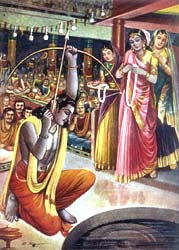
In some of the best known swayamvars in Indian legends, Sita had to wait for Ram to come along and break a massive bow, and Karna was disqualified on caste grounds, despite shooting the eye of a revolving bird while looking at its reflection in a pool of water.Juggling fast-paced lifestyles, todays aspirants face equally challenging tasks, if not as dramatic. Some online portals have recognised this market and offer virtual swayamvars, which is gaining popularity among the Gujarati communtity. The traditional marriage portal involves browsing through dozens, if not hundreds of profiles, contacting interesting-looking candidates, and waiting for days in the hope of a favourable response. The virtual swayamvar however, enables candidates (with similar preferences) from across the world to log on at a pre-decided time, and interact with a larger group of probables."More prospective Gujarati brides and grooms searching for marital partners online. So virtual swayamvar was conceptualised to help members of a particular caste or community connect with their prospective life partners beyond geographical boundaries. Members across the globe can log in and meet up with potential partners,” an official at a major matrimony services portal said.“A number of participants prefer this concept, since interaction is real-time, making it replies and decisions faster and more efficient.” Aarti Shah and Rishab Shah, who were recently engaged in Vadodara, met through such a swayamvar. Rishab, a city-based software engineer sais, “My parents constantly tried to get me to attend matrimonial meets, but I was not comfortable in such a setting, and found the concept of virtual swayamvar more interesting,” he says, adding, “I registered myself on a site, and since we were particular about caste and community, I participated in virtual swayamvars meant only for Jains. I interacted with many candidates and things clicked with Aarti.”Parents too, are moving toward this concept. Seema and Piyus Patel, who stay in Ahmedabad, have registered their daughter on such a site, hoping to find her a suitable husband. “Traditionally, even the online route is a long-drawn process of finding a candidate. In a virtual swayamvar, one can directly chat with the candidate. We think the virtual swayamvar would be a good place to find a match for our daughter,” they saidStill, in some cases, the search continues. Surat-based banker, Milind Makhija said: “As a busy professional, I dont have the time to go through profiles, intimate my interest, and wait for replies. That way, virtual swayamvars are much better. I have attended some virtual swayamvars and will attend some more, till I find a suitable partner.”

Sunday, December 14, 2008

Not many migratory birds flocking to central Gujarat

The number of migratory birds at Kaneval, Pariaj and Vadhvana has dropped from 1.4 lakh a decade ago to 40,000 now

Devanshi Joshi. Vadodara/DNA
Monday, December 15, 2008


Central Gujarat, formerly a major destination for bird watchers, is losing its charm. While Kaneval, Pariaj, Varasda near Anand, and Vadhavana near Vadodara previously played host to a large variety of migratory birds each winter, the number of these visitors has fallen in the past few years. Ornithologists say as many as 1,40,000 birds visited Kaneval, Pariaj and Vadhvana a decade ago. Now, this figure has shrunk to 40,000. At Varasda, this figure has gone from 28,000 a few years ago, to around 6,000. Experts say decreasing water levels in lakes and fields, coupled with bird hunting and poaching have led to the decrease. Dr. Hiren Soni, an ornithologist who has studied the wetlands of Vadodara and Anand, expresses his worry. “Fewer birds have been visiting Kaneval, Pariaj, Varasda and Vadhavana in the past few years. A decade ago, around 1,40,000 migratory birds came here. That figure has fallen to 80,000 in the past three years. According to the Asian waterfowl census in 1989, there were around 25,000 birds in Varasda. In 2002, there were only around 18,000. This year, only 7,000 birds seem to have visited Varasda,” said Soni.Each year, more than 35 types of migratory birds arrive at Kaneval, Pariaj, Varasda and Vadhavana around the end of October and stay till February or April. Flamingos, Moorhens, Storks, Spoonbills, Northern pintails, and Shovelers come from the colder areas in the north, to breed here. For the past few years, the water level in these lakes has been decreasing, since more water has flowed into the Bay of Khambhat and nearby canals, which are used to irrigate fields. This has resulted in the birds shifting to other places. Another reason behind the shift is overgrazing by local cattle, which creates a shortfall in plants that fish feed on. This, in turn, creates a shortage of the fish, on which the birds feed. This eventually leads to a food scarcity and, consequently, a decline in the population of migratory birds. Dhaval Patel, a wildlife lover who heads the Vidyanagar Nature Club, said, “The government should take steps to maintain the water levels in fields. The decreasing level of water in these fields is the main reason behind the fall in the number of migratory birds visiting the area. The water level in the region's lakes has also declined rapidly, making the place unsuitable for birds.” The fall in the number of migratory has also led to waning interest of tourists, who previously visited the area both from India and abroad.

At MSU hostels, anything goes

Neither students nor officials seem to care about rules, regulations

Devanshi Joshi. Vadodara/DNA

Monday, December 15, 2008

Like most others, the hostel halls under Vadodara's MS University have a list of rules. However, negligence, on the part of authorities and students alike, has led to a situation where anything goes. For instance, although an ID card system is supposed to be in place, many students don't have the requisite cards. Sources say some outsiders also stay at the hostel without permission. Under university rules, hostel residents are required to get permission, and pay a fee, to have overnight guests - another rule that is often ignored. Students also bypass the curfew timing, using proxies to mark attendance. Sociology student Mallika Singh, a resident of SD hall, says, “Our hall does not have a warden, making it easy for students to break the rules. Also, the management is not strict about taking action against offenders, so we have formed committees to fine students who do not follow the rules.” When DNA asked Dr DP Bharambe, chief warden of the MSU hostel, about loopholes in hostel management, he said, “The hostel halls have rules and regulations, which student residents are expected to follow. Strict action is taken when we get complaints that rules are being broken.” Sources say MSU's frequent plans for new rules rarely get implemented. This time, the university plans to introduce a punch-card system for hostel residents, to ensure that they return to the hostel on time. “We plan to introduce the punch-card system in hostel halls. As far as security and management of hostel halls is concerned, we are trying to implement the rules strictly. Students also need to understand the rules and regulations, and cooperate,” said vice chancellor Ramesh Goyal.

Friday, December 12, 2008

Wine keeps your heart healthy

Research shows drinking small amounts of wine everyday is beneficial

Devanshi Joshi. Vadodara/DNA
Friday, December 12, 2008
Consuming small amounts of red and white wine everyday can benefit one's health. According to research conducted by a US-based doctor, the daily consumption of red and white wine with food can prevent obesity, cardiac arrest, hypertension and ageing.Dr Nilanjana Maulik, of the department of surgery at the University of Connecticut's school of medicine in Farmington, was in Vadodara on Thursday to participate in a symposium on translational research in cardiovascular medicine. Dr Maulik, who has authored 140 papers on different subjects, has been studying the effects of wine for the past 10 years. Research conducted by her suggests that white and red wine ward off cardiovascular diseases. “White wine contains tyrosol, which is acts as a cardioprotective, while red wine contains only 6% of alcohol and is made from good quality grapes. So, a combination of white and red wine gives good results. It also controls glucose, and is thus helpful for those with diabetes.” As an anti-oxidant, Tyrosol can protect cells against injury due to oxidation. Its presence in white wine could be responsible for the protective effect, said Dr Maulik, whose team led the research at the University of Connecticut's Health Center in Farmington.She also commented on Gujarat's status as a dry state. “Limited consumption of alcohol can help fight many diseases, and so the state should have a liberal policy regarding wine. Good quality wines cost more and so are less available in India, compared to some countries, such as France,” she said.

Layoff victims take to blogs for help

Having lost their jobs, professionals log on to the net for advice on how to overcome trauma

Devanshi Joshi. Vadodara/DNA

Tuesday, December 08,2008

In current global recession, process of cost cutting has axed jobs of thousands of employees, especially in the US. Many of these jobless people are getting on with blogs to find the ways to survive post-layoff. Blog posts on different blog sites are flooding with the tips on how to survive a layoff and how to restart a work life again.Through personal, professional and group blogs, many employees who have recently lost their jobs, share their experiences of layoff and also discuss on the ways to overcome the situation by interacting with the co-sufferers and experts. Ritesh Shah, a US-based IT professional from Vadodara, has recently lost his job. Now he has turned to his personal blog to come out of the troubled waters. He says, "Getting information on current situation from the blogs of the financial experts and counsellors gives moral support to survive. After loosing the job, I have no work on hand to do; so I started getting on with my personal blog and shared my nightmarish experience there. Many people responded and shared the similar experience. In such a state, when you have lost the job, knowing views of the people who are also facing the similar situation, gives a feeling that you are not all alone. Besides, the tips given by experts give strength to restart."Shraddha Jha, an IT professional, returned to her hometown Vadodara, after her layoff from a job in a Bangalore based MNC. Like Ritesh, she is also now trying to overcome the situation and for that she has turned to blogs. "I find useful tips that help me survive a layoff and overcome this troubling situation; financially as well as mentally. Reading such blogs and discussing about the situation gives satisfaction of sharing. There are also chances of getting job through the interactions. Loosing the job makes a person down economically as well as socially. For me sharing my layoff situation on blog is a way to find solace and get on again with my professional life," Shraddha told DNA.'Our department is closing down shortly'; 'the jobs are moving to Asia', 'how can I get a local job?' 'my company is opting for cost cutting and I might loose my job what to do to save my job?' 'how to survive a layoff'?'; these are some of the questions which people ask on different blogs which also show ways to survive lay off situation. So, don't be scared and panic while facing a layoff, because now you are not all alone, and of course, blogs are always there to your rescue! Blogs written by bloggers who are career experts, psychologists, professionals and others offer tips on how to face layoff or a near future layoff. These blogs give advice to face the layoff financially, mentally and socially, help search new jobs and also offer tips on cost cutting in personal expenses and financial management. So, don't let the layoff panic affect you, spare some time for yourself and look for some of the useful tips available on blogs to survive a layoff.

Government should be empathetic in its approach towards us

Victims of muscular dystrophy out on wheelchairs to create awareness

Devanshi Joshi. Vadodara/DNA
Monday, December 08, 2008


Sanjana and Atul Goel, the sister and brother duo, have been suffering from muscular dystrophy - a genetic disease characterised by progressive weakness and degeneration of the skeletal muscles which control movement. Though the illness has made the two physically unfit, their spirits are still touching the skies. Nothing could prevent their nationwide mission that they have undertaken on wheelchairs for spreading awareness about muscular dystrophy.As part of their nationwide tour, undertaken at the behest of Indian Association of Muscular Dystrophy, Sanjana and Atul were in Vadodara recently. As a part of their awareness campaign, the wheelchair travellers visited Disha, a city based NGO that runs a school for such patients and Autism Centre.Muscular dystrophy is a critical illness that occurs generally among children. With the passage of time, the victims of the disease lose various functions. First, walking is affected, later they find difficulty in rising from sitting posture. Soon they are forced to take to wheelchairs. Though their brain functions normally, the muscles slowly keep deteriorating, and soon their independent existence turns into a nightmare. “There are about four lakh patients of this disability. Unfortunately, most of them do not confess and undergo treatment because of the fear of not getting a suitable match. In fact, with DNA tests and pre-natal tests, muscular dystrophy can be detected and treated. I know a quite a few disabled mothers who have given births to normal children,” Sanjna told DNA.There are various types of dystrophies and the inheritance pattern varies with each type. “The genetically inherent disease of muscular dystrophy affects children, and women are carriers of the disease. All the voluntary muscles of the body are more or less affected in the dystrophic process. The muscles involved in chewing food are the least affected while respiratory muscles are involved late in the disease. Tow to three cases of this disease come to me every month. The experiments on stem cell and other researches are still in test tube,” says Dr Bhavin Upadhyay, a city-based neuron physician.These two enthusiasts have been travelling on their wheelchairs all over the country to create awareness about the silent killer. “If the developed countries make life so easy for people on wheelchairs, why cant the Indian government do the same?” Atul asked. The duo appealed the government and the citizens to be empathetic; and not sympathetic, towards the people suffering from the disease.

MSU to put CCTV cameras in place

About 15 cameras will be set up at the main office in phase I

Devanshi Joshi. Vadodara/DNA

Tuesday, December 02, 2008

The terror attacks in Mumbai have made MSU authorities wake up to the potential security threat that the university may receive. The authorities have now planned to set up CCTV cameras to keep an eye on the activities taking place on the campus.MSU's security has become a matter of concern since its name appeared in the threat mail received soon after the Ahmedabad serial blasts. Checking of ID card and restricted entries were some of the measures the university had taken after the blasts. However, with passage of time, all these steps went into relaxed mode.According to the latest plan, the whole MSU campus will be monitored through CCTV cameras installed on the campus. Cameras will be set up in different phases. In the first phase, 10 to 15 cameras will be set up in the main office within 15 days. The security of MSU campus has always been a question as the security guards at various gates of the campus rarely check the I-cards of people entering the campus. University vice chancellor Ramesh Goyal finds installation of CCTV camera as a useful measure for adequate security on the campus. "To protect the university from any kind of violence, the authorities have decided to set up CCTV cameras at different places on the campus. Gradually, the whole campus will be covered with the cameras. We were planning to install camera for long but the work got delayed due to certain reasons."On their part, the students are supporting the MSU decision of setting up cameras on the campus. They say it is a good measure to keep an eye on the activities happening in the university. Kaushal Shah, a TY BCom student, said: "CCTV cameras will strengthen the security in the university and keep a check on the activities on the campus. Now with the terrorist attacks, safety has become an important issue and university like MSU needs to take action."Harikiron Rao, general secretary of MSU, said: "Installing CCTV cameras will be helpful for the internal security of the university. The cameras will help officials keep a watch on the activities happening on campus. This would also maintain discipline in the university."

Tuesday, November 25, 2008

Relaunched MSU website needs another launch

The poorly maintained website has old information
Devanshi Joshi. Vadodara/DNA
Wednesday, November 26, 2008


It may be the Internet age, but some officials at Vadodaras MS University are blissfully unaware that the varsitys website is outdated and ill-maintained. The sorry state of the site makes it difficult to even get basic updates about the universitys functioning. According to the homepage, nearly 35,000 students are enrolled at the university, which is one of the best known in Gujarat. Most of these students, especially the large base of foreign ones, prefer to gain access to academic and extracurricular information via the internet. However, a number of hyperlinks lead to dead or inaccessible pages, and of the ones that do open, many have incomplete information. Foreign student advisor at MSU, Sharad Bansal accedes that, “If the website is not functioning properly, it would be difficult for students to access information.” However, he is quick to shrug off the blame. “The technical department is responsible for the website. I am not aware about its working,” he says. MSUs website, www.msubaroda.ac.in, had been re-launched last year, with new features, but is not being updated regularly. The site still shows results of the last academic year and exam dates have not been updated, either. This is despite internal exams currently being conducted in a number of departments, with others scheduled to hold their exams in the coming months.In addition, the site does not offer any academic information, and only minimal details regarding the courses offered.Ramesh Goyal, at the start of his term as university vice chancellor, had assured the proper functioning of the website. But the situation remains largely unchanged in the roughly eight months since then. When asked about it, he said, “I admit the website is functioning at a less than optimal level. I have talked to the universitys technical department, who are working on the universitys website. We plan to re-launch it soon, with the latest updates.”To make matters worse, the contacts page of the site also has very limited information. Neither does it mention whom to contact in case of complaints or queries.

Thursday, November 20, 2008

Nano gets a thumbs up from designer Chhabaria

Devanshi Joshi. Vadodara/DNA Money
Thursday, November 20, 2008

"The indigenous design of Nano has proved that Indians are equally competent in smart automobile design aspects," Dilip Chhabaria, the renowned sports car designer, told DNA Money during his Vadodara visit on Wednesday.

"Accommodating all features into a tiny automobile needs smart thinking, and Nano is a well designed car. We have proved that Indian can design fine cars," said Chhabaria, in an interactive session about the design of Tata's mini car.

He himself has recently designed a sports car targeting youth as the niche market. The sharp features of the car, which is to cost nearly Rs30 lakhs, are aerodynamic and have an original flair. Up till now, European countries were ahead of India in design, but this status has been challenged, with Nano-the finest example of Indian creativity. Designing a small and economic car like Nano is a feat, and needs many aspects to be taken under consideration, along with design feasibility.

Chhabaria appreciated the economic price of the car too. He enthused, "Nano is not only the cheapest car but its design is up to the mark. We have heard so much about the car, but it remains to be seen how it will perform on the roads."

Women's police station meted shabby treatment

Inaugurated few days back, the station does not even have enough chairs and tables to sit and work

Devanshi Joshi. Vadodara/DNA
Thursday, November 20, 2008

Ideally citizens go to a police station to resolve their problems but where do the police go to resolve theirs? The question has been spurred by the dismal state of the womens police station at Vadodara, where lady police officials are working in a sorry plight without adequate infrastructure.

Only a few days back, the citys first womens police station had been inaugurated in a grand ceremony. It was aimed to make women comfortable with their complainants and the police station more approachable by having lady police officials.But the place is ailing with pitiful infrastructure, with no water facility in the toilet. The station does not have enough chairs and tables even to sit and work. Women police officials sit on the floor and take down complaints. The officials have to use the SSG hospital toilet, across the road.

A lady police constable on the condition of anonymity told DNA, “When people come for registering complainants, we cannot even offer them a seat, as we do not have adequate chairs to accommodate our own staff. We sit on the floor to work. For women, water is a necessity in the toilet. So we use the SSG hospital toilet.” When this police station was set up, all other police stations of the city had been ordered to provide chairs to them. But another police official revealed that anyway most of the chairs were broken and therefore useless.

When questioned about the affair, police commissioner Rakesh Asthana said, “The police station was set up in haste. And the plan to provide facilities is underway, but will take time. Even a new building is in the offing, but the time has not been scheduled yet. Water facilities in the toilet will soon be taken care of.” He indirectly tried to point out the limitations of the bureaucracy in reference to the above mentioned. But there seems hope yet, that the citys only womens police station will be given the importance it rightfully deserves.

Wednesday, November 19, 2008

V'dara witnesses grand wedding procession

Devotees join Narsinhji no varghodo and Tulsi vivah

Devanshi Joshi & Pratik Shah/ DNA.Vadodara
13th November,2008


The Sanskari nagri of Gujarat was all booming on city's landmark event of the wedding procession of Lord Narsinhji
on Dev Diwali. To Vadodara Narsinhji no Varghodo is what the Rathyatra is to Ahmedabad.
Amid tight security, the event marked ceremonial wedding procession of Lord Narsinhji who went to marry Tulsiji. Thousands of devotees from city and outside participated the marvellous procession.
Narsinhji no varghodo has become an identity Vadodara is the only city in Gujarat where Lord Narsinhji's procession has been taken out for over 125 years. the idol of Lord Narsinhji was taken out from Narsinhji ni pole at Mandvi and ceremoniously and taken to tulsivadi. Hundreds of devotee joined the residents of the Narsinhji ni pole in the procession as the relatives of the groom.
Devotees clad and rich traditional attire and kids in the fancy dresses fire crackers, music bands and devotional songs all were some of major attraction of annual fete. The varghodo started at 5:30 PM from Narsinhji ni pole reached Tulsivadi around 9:30 PM.
As the tradition goes, Lord Narsinhji, an incarnation of Lord Vishnu weds Tulsiji on Kartiki purnima, which is celebrated as Dev Diwali. The Lord's wedding ceremony was performed with traditional rituals which continued till the early hours of next day. After the wedding Tulsiji comes at Narsinhji ni pole along with Lord Narsinhji.
The police took all pain for the smooth passage of the procession. Before the procession began, the dog and bomb squads had undertaken security checks at every nook and corner of the procession route.

Narsinhji no Varghodo attracts NRGs and foreigners alike


The event has been a grand celebration for people of Vadodara

Devanshi Joshi. Vadodara/DNA
Tuesday, November 18, 2008

Narsinhji no Varghodo at Vadodara has its own identity as it is the only procession where Lord Narsinhji goes to marry Tulsiji on the day of Dev Diwali.

'Narsinhji no varghodo' in Vadodara has been a grand celebration for Barodians for more than 125 years but NRIs and foreigners also make it a point to come to Vadodara on the day of Dev Diwali to see the auspicious Narsinhji's customary procession.On Thursday, many non-resident Gujaratis participated as barati in Narsinhji no Varghodo.

Ajay Mehta, an NRG from Britain has been to the city especially for Narsinhji no Varghodo. Ajay said, "Every year I come to India and make it a point to come during Diwali time, so that I can celebrate the diwali as well as attend 'Narsinhji no varghodo'. Being Barodian, I have very good attachment and memories with 'Narsinhji no varghodo' as I have been participating in the procession since my childhood. Now the time has changed and I don't live in the city but 'Narsinhji no varghodo' is the celebration, which makes my visit to India definite every year."

Suketu Shah a student and an NRG from US visited 'Narsinji no varghodo' for the first time. Suketu said, "Being born and brought up in US, I have not seen Indian rituals much. This time fortunately my visit to India during the time of 'Narsinhji no varghodo' gave me an opportunity to become a part of Lord's auspicious wedding moments. I had been told by my grandfather to see the 'Narsinhji no varghodo' who also told me the religious importance of procession."

Not only NRIs but foreigners also visited 'Narsinhji no varghodo' with great surprise of seeing God's grand wedding followed by rituals ceremony. Michelle Clinston, a foreign visitor said, “India is a land of cultural values and its versatility always attracts any foreigners. I and my friends are enjoying our trip to India especially the colours of Indian culture and variety. My friend from Vadodara told me about the Narsinhji procession and we planned to visit Vadodara to see the procession. It is surprising to know that in India God's wedding is being celebrated with grand procession and the wedding season starts after Narsinhji's wedding.”